Trujillo, a city a few hundreds of kilometers south of Mancora occurs in a landscape of vast deserts of sand dunes, clay pans and eroded hills. Despite the almost complete lack of rainfall here the floodplains are rich with agricultural production which is provided by a vast water supply from rivers flowing from the Andes to the west. The oceans here are extremely rich in life, created by the flows of the Humbolt Current, which support a huge fishing industry.
These conditions gave the indigenous people of the region, the Chimu, vast resources for building an impressive civilisation with complex agricultural production systems and productive fishing techniques. These factors allowed the Chimu to support large populations of more than 200,000. The Chimu flourished from 900AD to 1300AD when they were conquered by the Incas.
Around the city of Trujillo many ruins remain, however due to their construction from predominantly mud brick many have been severely damaged by heavy 'El Nino' rainfall and the regular tsunamis that hit the coast here.
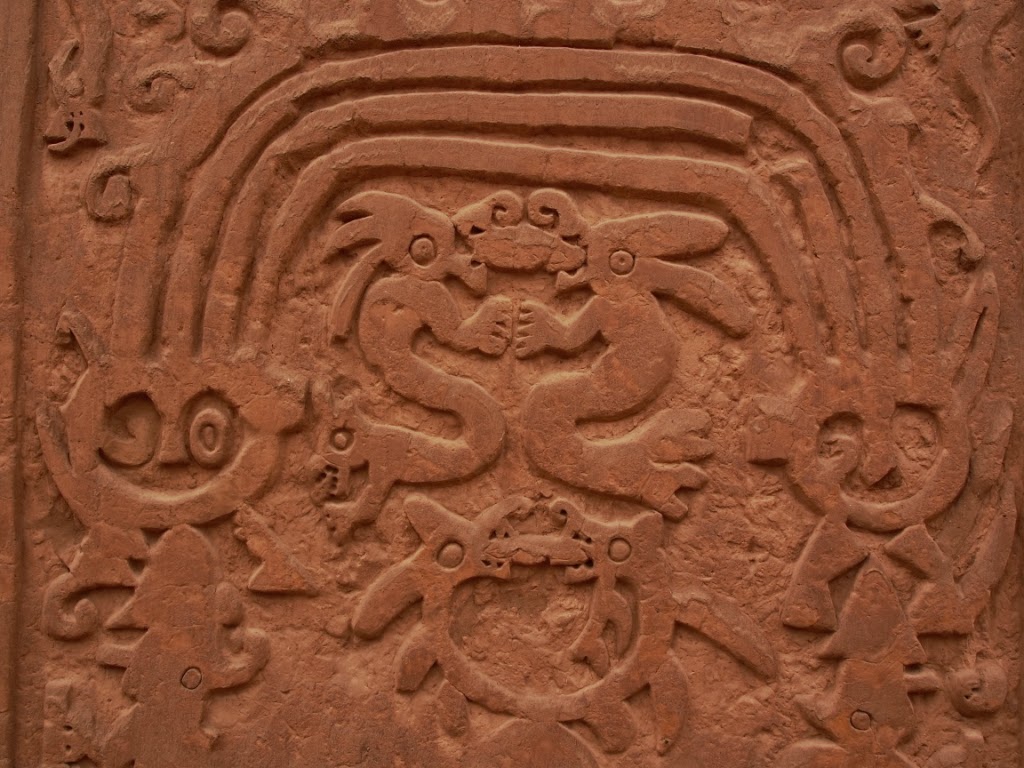
Chan Chan Ruins, easily the most impressive city in the region, covers an area of 20 square kilometers. The city is said to have supported over 200,000 people, and consists of houses, buildings and compounds all enclosed by large walls to 10m tall. The most significant structures were decorated with awesome carvings and were painted with an array of colours.


The temple of the sun and the temple of the moon are purely temples of worship where human sacrifices occurred to appease the gods. The temples were built between 100-500AD by pre-Chimu culture called the Moche.
Both structures are absolutely huge and were covered inside and out by impressive carvings painted in bright colours.
Both temples were almost entirely buried by the shifting sands of the desert. Archeologists began excavating and restoring the buildings in the 1970s. There remains a lot of work to be done to reclaim these ruins back from the desert.

What the ruins once looked like...